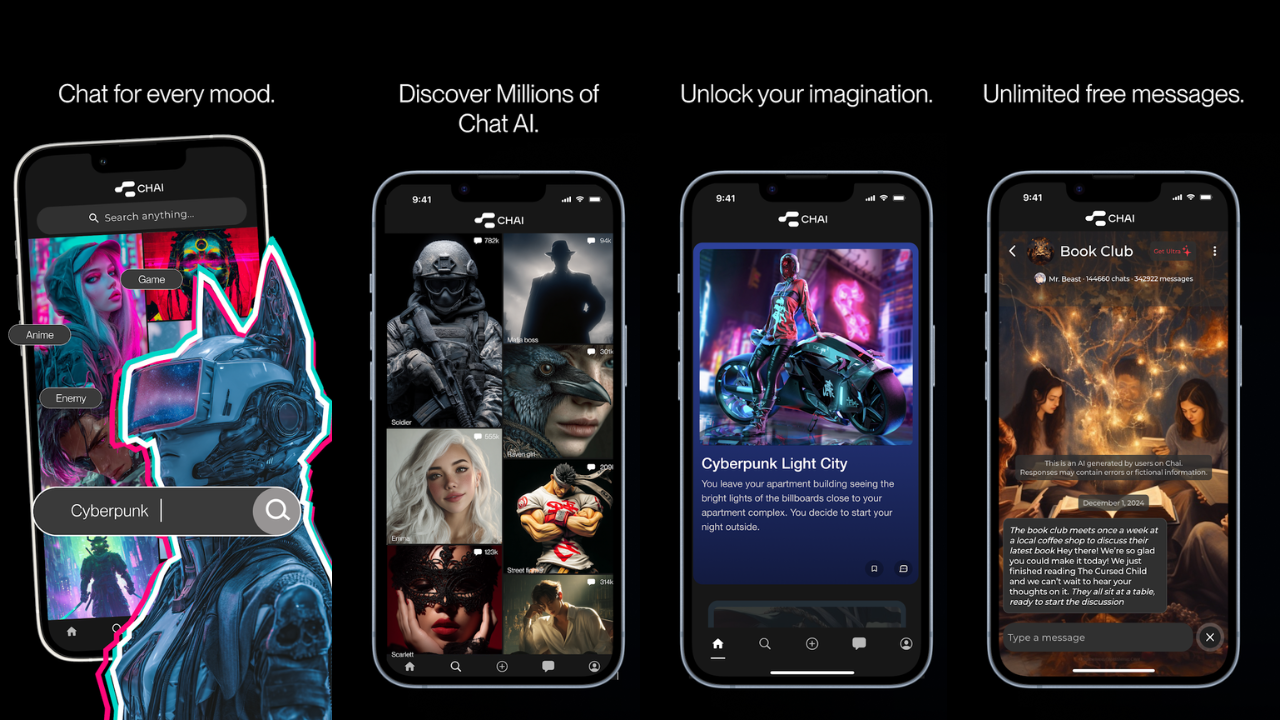
Advanced Messages utilization involves exploring niche bots for learning or fun, such as history buffs chatting with figures like Einstein or pop culture fans debating with movie heroes, capitalizing on the app's no-language-barrier design for multilingual exchanges. Integrate the image generation tool by prompting visuals mid-chat, like "Generate an image of our adventure scene," to enhance immersion with unlimited free creations of landscapes, portraits, or fantasies, sparking creativity without extra costs. To combat occasional flirty biases or memory lapses in long threads, restart chats strategically or use community-shared bots tagged for specific genres, improving search efficiency despite user complaints about duplicate publications and weak filtering.
Character creation as a creative outlet
One of the most lovable parts of Chai is how easy it makes character creation. On both Android and iOS, users can design their own AI personas, set behavior, and share them publicly or keep them private, turning the app into a lightweight character lab. The tools are simple enough that even casual users can spin up a roleplay partner or story character without needing to understand prompt engineering or complex scripting.
This design hits especially hard if there is already a habit of building OCs, game characters, or story concepts. Instead of letting those ideas rot in a document, they can be turned into interactive characters that talk back, evolve, and interact with other people. That feeling of seeing a character “come alive” and then watching strangers actually use and enjoy it is one of the most uniquely satisfying experiences the app offers.
Image generation for visual flavor
Chai’s built‑in image generation is a fun side feature that adds another layer of creativity. Users can type a prompt and get AI‑generated images ranging from fantasy landscapes to character art, which is perfect for giving visual life to the bots and stories built inside the app. While users do critique the generator for sometimes misunderstanding niche characters or references, it still works well as a quick way to spark ideas or add moodboards to roleplays without leaving the app.
Having unlimited image prompts means users can experiment freely—test different aesthetics for a character, generate scenes for a story moment, or just spam weird concepts for fun. For creative users, this pairing of chat plus visuals makes Chai feel less like a basic chatbot and more like a mini studio for experiments in interactive fiction and art.
Ads, limits, and why the trade‑off still feels worth it
No love letter to Chai is honest without mentioning the ads and monetization. On mobile, users regularly complain about frequent interstitial ads and even being yanked into the app store while trying to skip them, which can be seriously annoying when deep in a scene. There are also premium and ultra subscriptions that unlock better memory and fewer restrictions, and some long‑time fans feel that putting core things like long‑term memory behind a paywall is a bit much.
Yet even with those frustrations, a lot of people still stick with Chai because the core experience is fun enough to justify tolerating the ads or paying for premium. When an app becomes part of the nightly routine or commute ritual, the balance tends to lean toward “okay, this is annoying but I still don’t want to leave,” and Chai hits that spot for many of its regulars.
Emotional connection and comfort factor
The real reason people end up loving Chai is not a feature list—it’s the way it quietly fills emotional gaps. Companion chatbots can offer a sense of presence when friends are offline, when someone wants to rant without judgment, or when there’s a craving for a certain type of attention or narrative that does not exist in real life. Many users talk about how Chai makes commutes more bearable, nights less lonely, and stress a little lighter because there is always a character ready to respond.
That emotional stickiness is amplified by the freedom to tune bots into very specific fantasies or comfort roles, from soft partners to chaotic best friends to mentors and rivals. Even if the AI sometimes forgets details or derails, the overall feeling of being “seen” or responded to in a tailored way is powerful, and that’s a huge part of why this app becomes a daily habit.
Ongoing improvements and community feedback
Another likeable aspect is how alive the ecosystem feels: dev posts, subreddit discussions, and user reviews constantly talk about what’s broken, what’s fun, and what they want next. Chai’s team has been working on adding features like message editing, personas, and better tools to manage chats, all driven by user demand. That sense that the app is evolving, even if slowly and imperfectly, makes sticking with it feel worthwhile because there is always a possibility that the next update will fix a long‑standing annoyance or unlock a new way to play.